MED0001157212 - This website contains imagery which is only suitable for audiences 18+. All surgery contains risks, Read more here.

Breast lift (mastopexy) with Dr Terrence Scamp

Breast Lift Gold Coast (Mastopexy)

A breast lift, or mastopexy, restores the position and shape of the breasts when the skin and supporting tissue have stretched. On the Gold Coast, the procedure is performed by Dr Terrence Scamp. Dr Scamp provides consultations at his new 95 Upton Street Clinic. He holds MBBS and FRACS qualifications and has practised cosmetic plastic surgery on the Gold Coast since 1995.

Breast lift & Motiva bg 01

What to know before a breast lift

Most patients considering a lift have noticed changes after pregnancy and breastfeeding, after significant weight loss, or after years where the skin has gradually lost elasticity. The procedure addresses drooping and excess skin. It does not, on its own, change breast size. If size is also part of the picture, whether more or less, an implant or a reduction can be performed in the same operation.

The best results come from patients who are close to their long-term weight and have finished having children. Pregnancy and breastfeeding after a lift can stretch the tissue again and undo the correction, and future weight change works against the reshaping.

A lift is not a weight-loss procedure. It removes skin, not fat, and it does not alter breast volume unless combined with something else. It cannot restore the exact fullness of a much younger breast either. What a lift can reliably do is raise the position of the nipple and areola, tighten loose skin, and reshape the breast so it sits higher on the chest wall. If more upper-pole fullness is part of a patient’s goal, an implant is usually needed alongside the lift.

Smoking, an unstable weight, and unmanaged medical conditions all affect suitability and healing. Dr Scamp will assist with specifics during consultation.

Who is a suitable candidate for surgery?

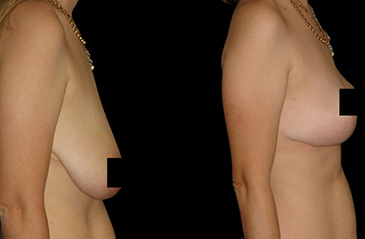
A mastopexy aims to remove excess skin and reshape or reposition the breasts. Each procedure may be slightly different, in accordance with each patient’s goals and natural proportions.

To find out if a candidate is suitable for the procedure, the first step is booking an initial consultation with Dr Scamp. This allows the patient and Dr Scamp to discuss health and physical concerns, as well as individual reasons for seeking mastopexy. Generally, patients with health issues that may impact the success of the surgery will not be suitable. It is also typically not suitable for women who are pregnant, breastfeeding, or planning to have more children in the future.

A breast lift is suitable for women who have concerns about skin laxity around the breasts due to ageing, weight loss, or pregnancy. The procedure may address these concerns with an incision technique, reshaping the breasts and removing any excess skin, while the nipple and areola are repositioned. In addition, the areolae can be reduced in size if they have become stretched.

View Full Gallery

The breast lift procedure

Surgery is performed in hospital under general anaesthesia and takes around two hours. The incision pattern is matched to the amount of correction needed.

For a mild lift, a scar around the areola alone can be enough. For moderate drooping, that circular scar is extended vertically down to the breast crease, forming what surgeons call a ‘lollipop’ pattern. Significant lifts add a horizontal line along the crease, an anchor or inverted-T pattern. The greater the change, the longer the scar, and this trade-off is one of the main things Dr Scamp works through when planning each patient’s surgery.

During the operation, excess skin is removed, the underlying breast tissue is repositioned, and the nipple and areola are moved to a higher position on the chest wall. The blood supply and nerve pathways to the nipple are preserved wherever possible. If the areolae have stretched over time, they can be reduced in size at the same sitting.

Breast lift recovery

The first week is the most restrictive. Movement is possible but limited, and the patient will need help at home with anything that involves lifting or reaching overhead. A surgical bra is worn day and night for around six to twelve weeks. The bra matters more than most patients expect. It holds the reshaped tissue in position while the internal healing takes place, and skipping it can compromise the shape.

Most patients return to desk-based work at around one week. Light activity resumes gradually from the second week. Upper-body exercise is the last thing to come back, generally from four to six weeks under Dr Scamp’s guidance.

The shape patients see immediately after surgery is not the final shape. Over the following weeks, the breasts drop and settle into a softer, more natural position. This is normal and expected. The scars have their own timeline. They tend to look their worst around four to six weeks post-surgery, then gradually flatten and fade over the twelve to eighteen months that follow. Scars are permanent but usually become considerably less noticeable with time and proper scar care.

How long the results last comes back to what happens next. Pregnancy, breastfeeding, significant weight change, and the ongoing effects of gravity and age all continue to shape the breasts. A stable weight and a completed family typically hold the results the longest.

Request a consultation

If considering a breast lift, the next step is a consultation with Dr Scamp at his Bundall Clinic at 95 Upton Street on the Gold Coast.

Frequently Asked Questions

What is a breast lift?

Who is a good candidate for a breast lift?

Will the patient have visible scars?

Will nipple sensation change?

Can the patient breastfeed after a breast lift?

How long will the results last?

Can a breast lift be combined with implants or a reduction?

How much does a breast lift cost on the Gold Coast?